AI note takers made recording meetings so easy that most people stopped asking whether they should. The law did not change, though. Whether you record audio or "only" transcribe it, you are capturing what other people say, and most legal systems care about that.
This is general information, not legal advice. Rules vary by country, state and industry, and they change. If you work in a regulated field (health, finance, legal, HR investigations) or record at scale, check with a lawyer.
The short version
- Tell everyone at the start that you are transcribing or recording, and why.
- Give them a chance to say no, and respect it.
- Keep the result only as long as you need it, and do not share it more widely than the meeting itself.
Do that, and you are fine in nearly every jurisdiction. The rest of this article explains why.
United States: one-party vs all-party consent
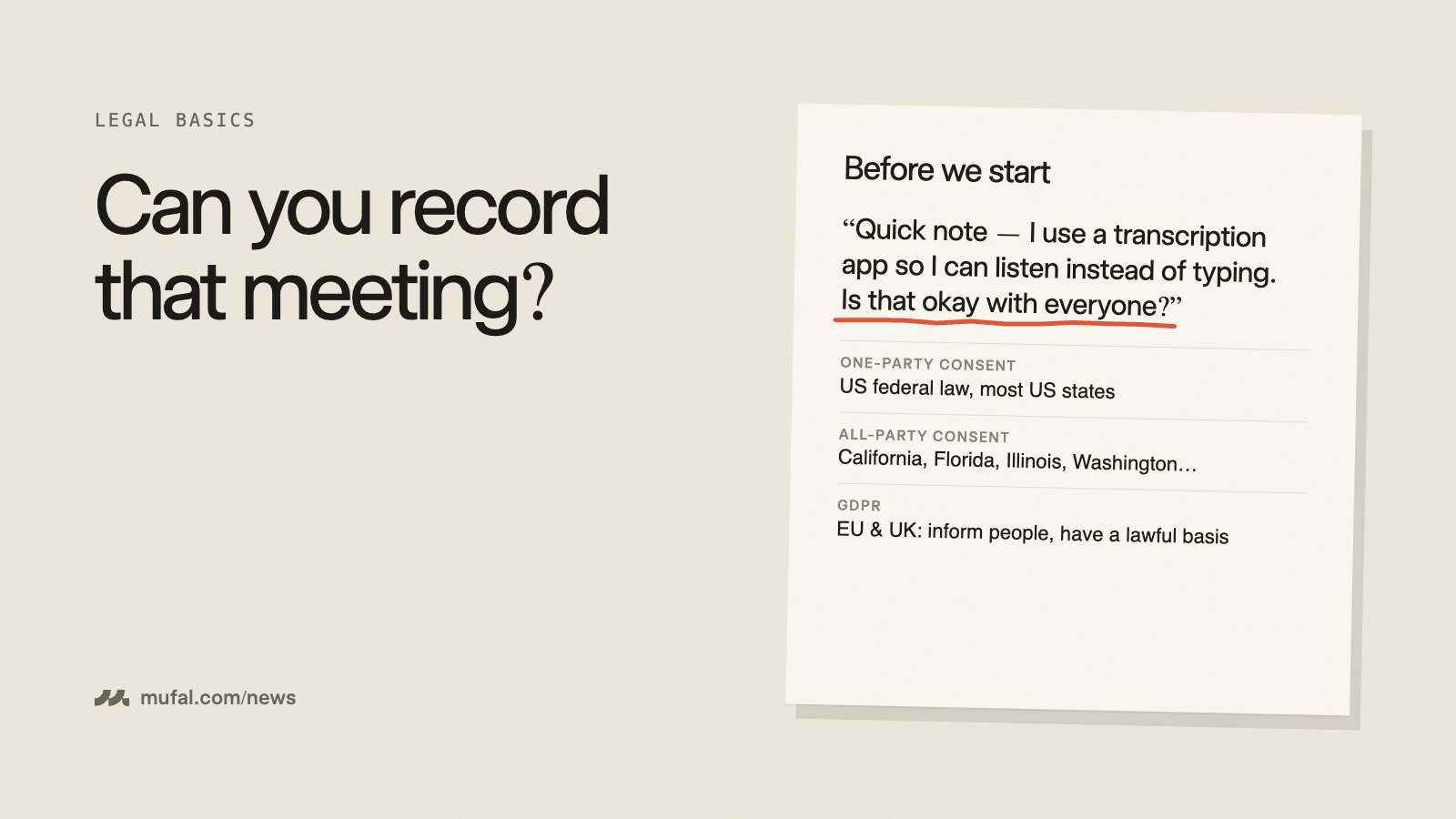
Federal law (the Wiretap Act, 18 U.S.C. § 2511) is a one-party consent rule: you may record a conversation you take part in, as long as you are not doing it to commit a crime. Most states follow the same rule.
A group of states require all parties to consent, at least in some situations. They commonly include California, Florida, Illinois, Maryland, Massachusetts, Montana, New Hampshire, Pennsylvania and Washington, with partial or situation-specific rules in states such as Connecticut, Nevada, Oregon and Michigan.
Remote meetings make this messy, because participants can be in different states. The practical rule most companies follow: if anyone on the call might be in an all-party state, act as if all-party consent applies. In other words, ask.
Europe: GDPR and national criminal law
In the EU, a recording or transcript of a meeting contains personal data, so the GDPR applies. Two obligations matter most:
- Transparency: people must be told that their words are being captured, by whom, for what purpose, and how long it will be kept.
- Lawful basis: for a business, this is usually legitimate interest or consent. Either way, you need to be able to explain why capturing the meeting was necessary.
Several countries add criminal law on top. In France, recording someone's private words without their consent is an offence under article 226-1 of the Code pénal. In Germany, section 201 of the Criminal Code protects the "non-publicly spoken word". In practice, this makes Europe effectively all-party: inform everyone, and do not record people who object.
United Kingdom
An individual can usually record a conversation they are part of for personal use. Once a business uses the recording, UK GDPR applies with the same transparency and lawful basis requirements as in the EU. Telling participants at the start covers the first part.
Canada
Under the Criminal Code, a participant may record a conversation they are part of (one-party consent). Organisations collecting personal information in the course of business also fall under privacy laws such as PIPEDA, or Quebec's Law 25, which expect people to know what is being collected and why.
Does "transcription only" change anything?
Not much. Some tools, including Mufal, do not keep an audio file, only the text. That reduces what is stored, but a transcript is still a record of what people said. Treat it the same way as a recording: inform people, keep it for a reason, delete it when you no longer need it.
Also note that the audio is still processed by a speech-to-text service while you transcribe. Mufal, for example, sends audio to AssemblyAI to produce the text. Our privacy guide lists exactly what goes where.
A sentence that works almost everywhere
Say it at the start of the call, before the conversation gets going:
"Quick note: I use a transcription app so I can listen instead of typing. Is that okay with everyone?"
It takes five seconds. Most people say yes, and the ones who say no tell you something useful about the meeting. If someone objects, stop the transcription and take notes by hand.
Bots vs desktop apps
A bot that joins the call announces itself in the participant list, which is a form of notice, but not a substitute for asking. A desktop app like Mufal does not appear in the call at all, which is why saying it out loud matters even more. No bot is a better experience for everyone; it is not a reason to skip consent.
Further reading: AI notetaker without a meeting bot and what privacy-first means for a meeting assistant.